
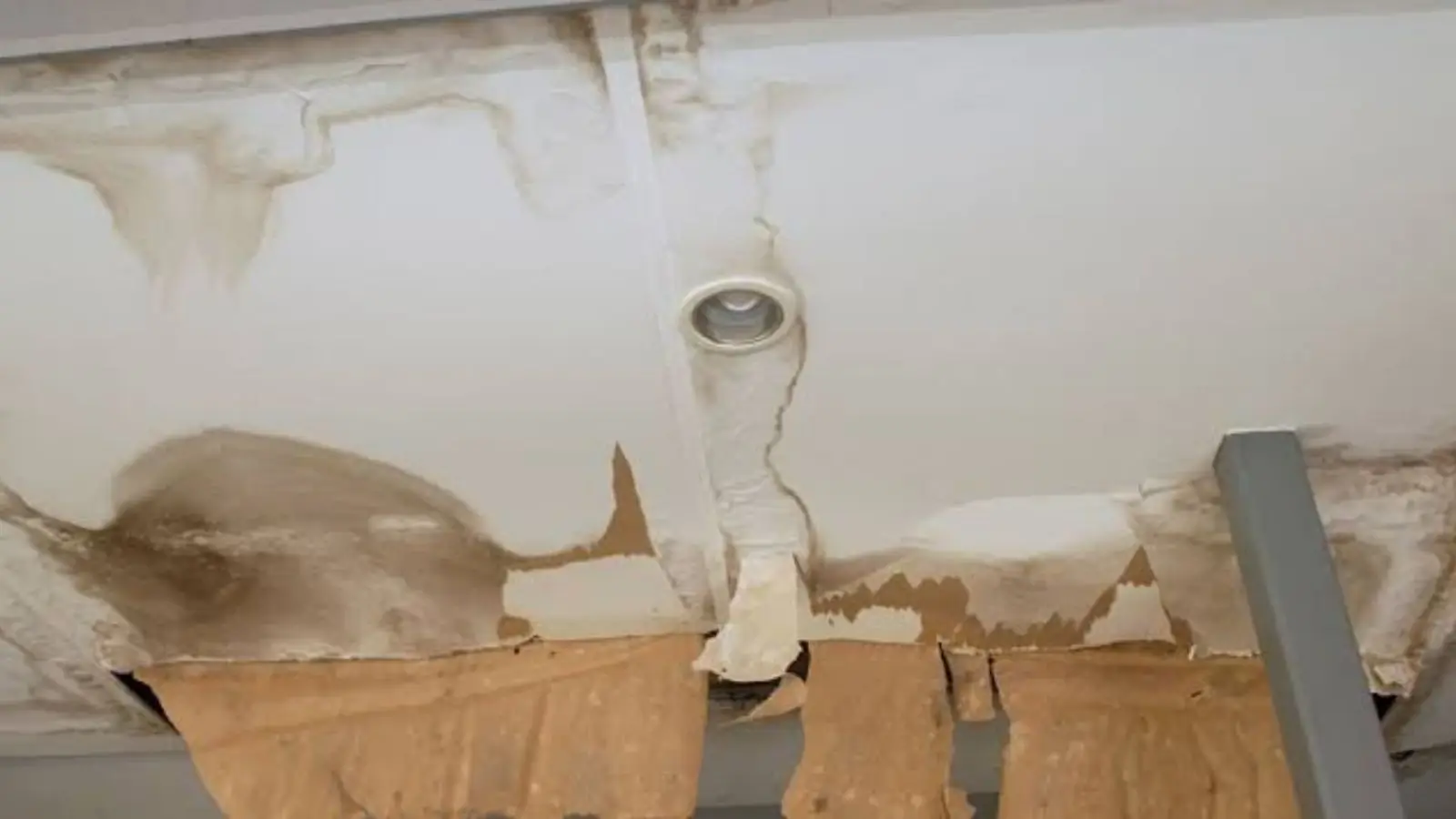
A water damaged ceiling rarely announces itself with a gush. It starts as a tan ring, a faint bubble in the paint or a drip after the shower, then one day the drywall droops under the weight of the water it has trapped.
This guide helps you tell a dry old stain from an active leak, explains why a bulging ceiling can be dangerous, and walks through the safe way to drain it. You will also see which problems call for a plumber, a roofer or a restoration crew.
Reading the stain: old, active or spreading
Color and edges tell most of the story. A pale yellow or brown ring with a crisp outer line often marks a leak that dried and came back several times, like a roof flashing that only fails in heavy rain. A dark, damp-looking patch with soft edges is usually active right now.
Press the stain gently with a gloved hand or a broom handle. Drywall that feels firm and dry is probably an old problem, while spongy, cool or crumbly material means the gypsum has absorbed water. A quick pass with a pin meter or an infrared camera tells you whether the sag is holding water, and no one has to open the ceiling to find out.
Check the room above and the attic too. A bathroom, a laundry area or an air conditioner drain line directly overhead is the usual suspect, and water often travels along a joist for several feet before it drips.
Bulging and sagging: when to treat it as an emergency
Drywall that has pooled water bulges downward like a belly. A square foot of ceiling can hold a surprising amount of water, and the weight can pull the board off its screws without warning. If the sag is large, spreading or dripping steadily, treat it as a ceiling that could fall.
Before you touch a bulging ceiling
Water, wiring and gravity make a dangerous mix, so go slowly.
- Keep people and pets out of the room and away from the area directly under the bulge.
- Dripping from a light fixture, ceiling fan or outlet box means the circuit should be shut off, but flip that breaker only if your feet are on dry floor and the panel is easy to reach. Otherwise call 911 or your utility.
- Do not poke the bulge while standing underneath it or while a ceiling fan is mounted there.
- Stop the source first. Shut the fixture valve or the main water valve if a pipe is involved.
- Never stand on a wet floor and reach toward a wet light fixture.
Call (626) 879-0276 if the ceiling looks ready to fail. Someone answers the dispatch line at any hour, and the first call walks you through safe steps for the sagging section while a crew is on the way.
How to drain a water filled ceiling safely
Relieving the pressure is better than letting the board collapse on its own. The goal is a controlled drain, not a demolition. Only do it if the room is clear of power hazards and you can stand to the side of the bulge.
Protect the floor
Move furniture out, lay plastic sheeting and set a large bucket or tub under the lowest point of the bulge.
Make a small hole
Stand beside the bulge, not under it, and poke a screwdriver through the lowest point so the water runs out in a stream you can direct.
Add relief holes
Make a few more small holes if the water slows, then let it drain until it stops dripping.
Photograph and call
Take photos of the ceiling before and after, then call for a moisture assessment, because the insulation and framing above are probably still wet.
Draining does not make the ceiling dry. It only prevents a collapse, so the next step is emergency water removal and drying of the wet materials above and behind the drywall.
Who fixes what: finding the real source
A ceiling stain is a symptom, so the repair order matters. Fix the leak, dry the structure, then rebuild the surface. Skipping any step leaves a stain that returns.
| Where the stain shows | Likely source | First call |
|---|---|---|
| Under a bathroom or laundry | Supply line, drain, shower pan or toilet seal | Plumber, then a drying crew |
| Near an exterior wall or corner | Roof, flashing, gutters or siding | Roofer, then a drying crew |
| Under an attic air handler | Clogged condensate line or drip pan | HVAC technician |
| Spreading with no obvious source | Hidden pipe or slow leak in the wall | Leak detection, then plumber |
| After a heavy storm only | Roof or window leak | Roofer or window contractor |
A restoration crew is not a plumber or a roofer, and a good one will say so. What a crew does well is measure how far the water went, remove what cannot be saved and dry the rest with air movers and LGR dehumidifiers. That is the core of water mitigation.
What drying the ceiling cavity involves
Painted drywall on the surface may look dry within a day while the insulation and the framing above stay soaked. Wet insulation holds water against the board and against the wood, so it usually has to be removed. Crews cut access holes, pull wet batts and use the meter to find the edge of the damage.
Sometimes a small drilled hole and a portable dehumidifier are enough. Large areas, plaster or a ceiling that has already sagged normally come down, because wet drywall loses its strength and a patch cannot restore it. If mold growth is already visible, containment and negative air come into play, and mold remediation follows the S520 standard as a published industry practice.
Once everything reads dry, the rebuild begins with new board, tape, texture and paint. For a wet ceiling job, ask the company if its drying plan follows ANSI/IICRC S500, the industry's published restoration standard.
Ceiling checklist before the crew arrives
- Note the date you first saw the stain and any rain or plumbing use around that time.
- Photograph the ceiling from several angles, plus the room above if you can reach it safely.
- Move furniture, rugs and electronics out of the room or to the center under plastic.
- Empty drip buckets regularly and keep a towel on any wet floor.
- Save a sample of any material you remove if the insurer wants to see it.
- Keep receipts for buckets, tarps, fans and any emergency repair.
Ceiling sagging or dripping now?
Reach dispatch at (626) 879-0276 any hour of the day or night, and ask about a same-day visit to the sagging area.
Cost factors and the insurance note
Ceiling repair is priced by what has to be done, not by the stain. Price moves with how dirty the water was, how much ceiling area got wet, whether attic insulation has to come out, how long drying equipment runs, and the amount of texture and paint afterward. Phone (626) 879-0276 to hear exactly what the ceiling job includes and what it costs ahead of the first cut.
A supply line that splits overnight is the kind of event many policies pay for, but a drip left alone for months often falls outside coverage, so read your policy and put the question to your insurer. Water that enters from outside as a flood is generally carved out of homeowners coverage.
Water damaged ceilings and permits in La Puente
La Puente's Building & Safety Division enforces standards for construction, alteration and maintenance of buildings, and its permit types include building, electrical, mechanical and plumbing. A ceiling rebuild with new wiring or a relocated fixture can touch more than one of those categories. Before you approve any ceiling scope, find out from the city's Building & Safety staff whether a permit applies.
A contractor pulling permits for your ceiling should show a city business license plus a state contractor card, and you are entitled to look at both. For homes in Hacienda Heights, land use belongs to Los Angeles County rather than a city, which means the permit conversation goes to the county instead of a city counter.
West Covina has its own Building Division at 1444 W Garvey Ave S, and it accepts applications through its Building Submittal Portal or at the counter. If your ceiling repair crosses into structural or electrical work there, ask the division which route applies.
Frequently asked questions
Is a bulging ceiling from water dangerous?
It can be. The drywall may hold a large weight of water and can collapse without warning, and wet fixtures add an electrical risk. Keep people out from under it and call for help.
Should I pop a water bubble in my ceiling?
A controlled drain is safer than waiting for it to burst on its own. Stand to the side, use a screwdriver on the lowest point and catch the water in a bucket, but skip it if wiring or a fixture is wet.
How do I know if a water stain on the ceiling is still active?
A damp feel, soft drywall, a growing ring or a fresh drip after rain or plumbing use points to an active leak. A moisture meter or thermal imaging camera confirms it without opening the ceiling.
Can a water damaged ceiling be repaired or must it be replaced?
A small, clean-water stain on solid drywall can often be dried, primed and repainted. A sagging, crumbling or contaminated ceiling usually comes down. See water damage repair for the rebuild step.
Does a Hacienda Heights ceiling leak need a county permit?
Hacienda Heights is unincorporated, so permit questions go to Los Angeles County rather than a city. Ask the county before major work, and see Hacienda Heights water damage restoration for coverage. West Covina homeowners can see West Covina water damage restoration.