
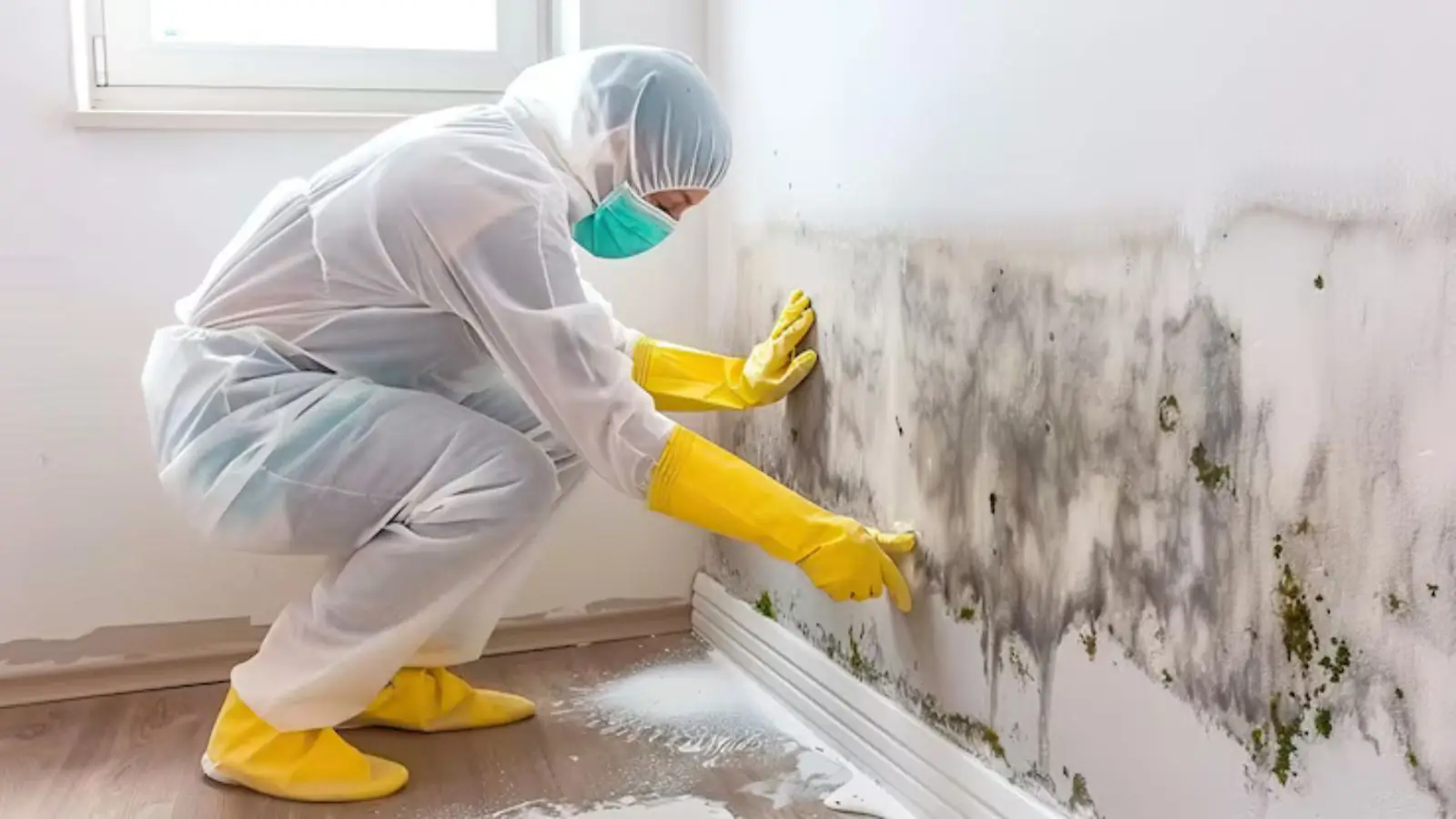
Learning how to remove mold from walls starts with the water, not the stain. Mold needs moisture to grow, so scrubbing a wall without fixing the leak behind it only clears the surface for a while. EPA guidance pairs cleanup with repair: wiping growth off a wall does little unless the leak or humidity feeding it is also fixed.
This guide explains how a wall is assessed, what a small cleanup looks like, and where the line sits between a homeowner job and professional mold remediation.
Step one is the water source
Mold on a wall almost always traces to a recent leak or a steady moisture source. Common culprits are a toilet supply line, a sink drain, an AC condensate line, a roof leak or siding that lets rain behind the wall. Until that source is found and repaired, any cleanup is temporary.
Look for the pattern. A stain that grows toward the floor often points to a plumbing leak, a ring around a window suggests a flashing or seal problem, and a patch above a ceiling line points up toward the roof or an attic duct. Meters and an infrared camera let a tech follow dampness inside the wall before it shows on the paint.
Dry the structure as well. Speed matters because the EPA's drying guidance is 24 to 48 hours, and crews meet it using air movers paired with LGR dehumidifiers. Our page on water mitigation covers how the first days of drying are handled.
How a moldy wall is assessed
An assessment answers three questions. How large is the affected area, what is the material behind the paint, and is the moisture still active? Porous materials such as drywall and insulation are harder to clean than tile, glass or sealed wood.
Mold on the surface often has more growth behind it. A professional may open a small inspection hole or use a borescope to see inside the cavity. Do not cut into a wall that may hold mold without containment, because dust carries spores into the rest of the house.
Testing is a separate decision. A visible, confirmed problem usually does not need a lab sample to justify cleanup, and independent clearance testing after remediation is explained in the page on mold work.
Small area or professional job
EPA guidance says a homeowner can usually handle mold covering less than about 10 square feet, which is roughly a three foot by three foot patch. Bring in a professional once the patch gets large, the wall was soaked through, or sewage was part of the water. Use the table to place your own wall.
| Situation | Usual route | Reason |
|---|---|---|
| Under about 10 square feet on a hard, sealed surface | Homeowner cleanup | Detergent and water scrubbing, then complete drying |
| Mold on drywall or paper facing | Remove and replace the material | Porous board cannot be cleaned back to clean |
| Over about 10 square feet or several walls | Professional remediation | Containment and extra controls are needed |
| Mold after sewage or contaminated water | Professional only | Contaminated water needs specialist handling |
| Recurring mold in the same spot | Find the moisture source first | Cleaning without repair repeats the problem |
These are general guidance lines. The right answer for your wall depends on what is found when it is opened.
Before you touch a moldy wall
Disturbing mold can spread spores through the home.
- Turn off the HVAC system so spores are not pushed into other rooms.
- Wear an N95 respirator, gloves and eye protection if you handle any cleanup.
- Do not dry brush, sand or spray bleach on moldy drywall.
- Stop and call a professional if the area is large, the wall is soft, or anyone at home has breathing problems.
- Keep children and pets out of the room until the job is done.
What a small cleanup involves
For a small hard-surface patch, EPA describes scrubbing with detergent and water and then drying the area fully. Soft materials such as ceiling tile, carpet and insulation that are moldy are normally bagged and discarded. Avoid mixing cleaning products, and do not dry-brush mold, since that sends spores into the air.
- Fix the leak and confirm the area is drying.
- Put on gloves, eye protection and an N95 type mask, and keep other people and pets out of the room.
- Close the room door, run a window fan outward if possible, and keep the HVAC system off for that room.
- Scrub the hard surface with detergent and water, rinse with a damp cloth and dry immediately.
- Bag removed porous material in plastic before carrying it out.
- Recheck the wall over the next weeks for staining or a musty smell.
If it reappears, stop and treat it as a moisture problem. No cleaning method can promise that mold will never grow again on a wall that gets wet.
What professional wall mold removal looks like
A crew working to the ANSI/IICRC S520 standard for professional mold remediation sets up containment first. That means plastic sheeting, negative air containment with HEPA air scrubbers, and protective gear for the workers. Affected drywall is cut out and bagged, framing is cleaned with HEPA vacuums and damp wiping, and the cavity is dried.
Any company you consider can be asked if it follows S520, which is a published industry standard rather than a brand claim. After removal, the wall is rebuilt only when readings show it is dry. Ask your insurer how mold is treated in your policy, and ask a physician about any health question, since that is outside what a restoration company can answer.
Mold bigger than a hand towel?
Dial (626) 879-0276 to hear what a wall assessment includes, with the scope and cost discussed before work begins.
Wall mold checklist
- Leak found and repaired before any cleaning
- Measured the visible area (under or over about 10 square feet)
- Photographed the wall before disturbing it
- Noted whether the material is hard and sealed or porous
- Kept the HVAC off and the room closed during work
- Bagged and removed moldy porous materials
- Dried the cavity and confirmed with a moisture meter
If your moldy wall is in a neighboring town, the same La Puente based crews also travel to Baldwin Park and West Covina.
Wall mold and sewer lines in La Puente
EPA guidance says sewage or contaminated water in a home calls for a professional. In nearby West Covina, the Public Works Maintenance Division, Street and Wastewater Section, maintains the city sewer and storm drain systems. If a backup comes from the public main, that department is responsible for the main, while a blockage on your own lateral is a plumber's job.
Census data puts owner-occupied housing in West Covina at 60.3 percent, so many wall repairs are paid for by the household that lives there. Write down who did what and when. That log is useful if you later talk with an insurer or sell the property.
Wall mold after a drain or sewer backup is a different job from a leaking window. Keep children and pets out of the area and call the city or your plumber to find the cause before any cleanup starts.
Frequently asked questions
Can you just wipe mold off a wall?
For a small hard-surface patch, EPA describes scrubbing with detergent and water and drying the area completely. On drywall or other porous material, wiping usually does not remove growth inside the material. The leak behind it still has to be fixed.
When should you call a professional for mold on a wall?
When the area is larger than about 10 square feet, when the water damage is extensive, or when sewage or contaminated water is involved. A recurring patch in the same spot also warrants an assessment. A crew can open the wall and trace the moisture.
Does bleach get rid of mold on walls?
Bleach is not what EPA points to as a routine fix, and it does little for porous drywall. The cleanup method is physical removal and drying. Never mix bleach with other cleaners.
Will wall mold come back after removal?
Mold needs moisture, so the answer depends on whether the wall stays dry. No one can promise it will not recur. Fixing the water source and checking the wall over time are the best protection.
Who do I call in La Puente if sewage backs up and a wall gets wet?
Contact a plumber for the blockage and a professional restoration crew for the wet materials. If you believe the backup is in the public main, ask your city or sanitation agency which office handles it. Do not clean contaminated materials yourself.