
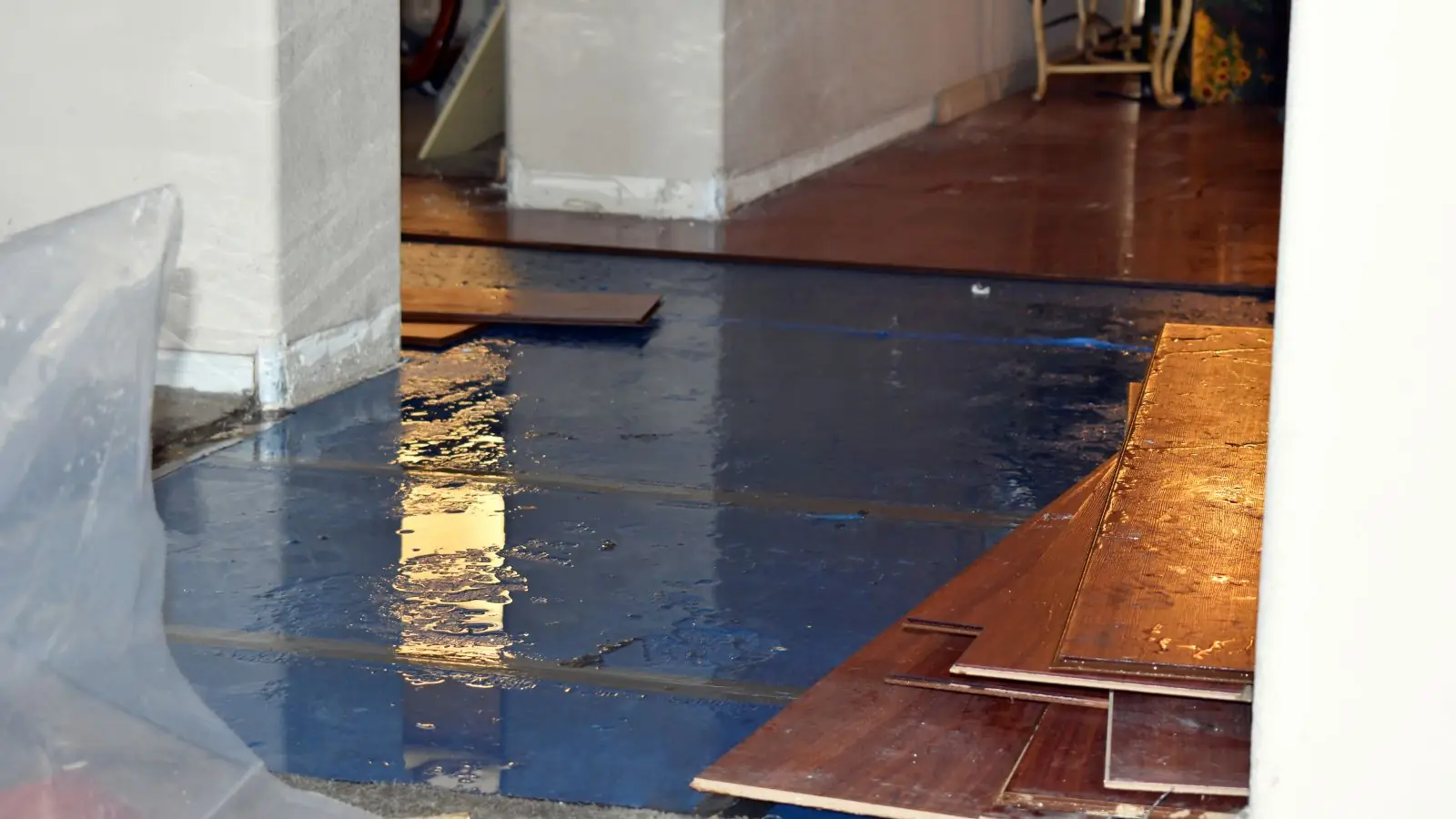
Hardwood floor repair after water damage starts with one question: how wet did the wood get, and for how long? A quick spill that you mop up in minutes behaves very differently from a slow dishwasher leak that soaks the boards from underneath for days.
This guide walks through cupping, crowning and buckling, shows how crews dry a wood floor, and gives you a simple table for choosing between repair and replacement. It also covers what to photograph and what to do in the first two days.
What water actually does to wood
Wood is a sponge with a grain. Boards soak up moisture from the face, the edges and, most importantly, the underside, and each board swells across its width faster than along its length. A kiln-dried floor normally sits around 6 to 9 percent moisture content, so a reading of 15 or 20 percent tells you the planks are holding far more water than they were built for.
That swelling is what you see. The edges push against the neighboring boards, the floor rises, and the shape of the board changes. Whether it returns to normal depends on how much water went in, how fast it came out, and whether the floor was nailed over a plywood subfloor, glued to a slab or floated.
Most of the damage is hidden. A floor can look only slightly wavy while the subfloor and the cavity underneath stay wet, which is how mold gets started. Wood soaks up moisture and swells, so the EPA's 24 to 48 hour drying window for avoiding mold is tighter for oak planks than it is for tile.
Cupping, crowning and buckling, in plain terms
Cupping means the board edges are higher than the center, so each plank looks like a shallow dish. It usually points to moisture coming up from below, like a slow supply line leak or a wet crawl space. Crowning is the reverse, with the center higher than the edges, and it often shows up after a cupped floor has been sanded while still damp.
Buckling is the serious one. The boards lift off the subfloor, sometimes by several inches, and you may hear cracking as they pull away from the nails or adhesive. A buckled floor has been saturated, and in most cases the pieces that lifted will need to be replaced even if the rest dries well.
Gaps, stains and black marks
Gaps between boards after the floor has dried are normal shrinkage, and they often close again with the seasons. Dark stains that follow the grain are different. They point to water that sat on the surface or a contaminated source, and they usually do not sand out.
Repair or replace: a decision table
The table below is a starting point, not a verdict. Your eyes cannot judge moisture buried in a board, and a trained tech with meters and an infrared camera can. Read these as typical outcomes, not promises.
| What you see | Usually | Main reason |
|---|---|---|
| Mild cupping, caught within a few days, clean water | Dry in place, then sand and refinish | Boards often flatten as the moisture drops |
| Cupping that stays after the floor reads dry | Sand once readings stabilize, or replace the worst boards | Permanent set in the wood |
| Buckling or boards lifting off the subfloor | Replace the lifted section | Fasteners and glue bond have failed |
| Dark staining, odor or a long soak | Replace affected boards, check the subfloor | Prolonged moisture and possible mold growth |
| Sewage or flood water on the floor | Replace, then sanitize the area | Category 3 water carries contamination |
| Engineered planks with swollen edges | Often replace | The thin top layer separates from the core |
If your boards are tongue and groove solid oak or maple, you have more options than with thin engineered planks. Solid wood can be sanded and refinished several times in its life, while a thin wear layer may allow only one light pass.
How a wood floor is dried without ruining it
The goal is steady, controlled drying. Blast a wet floor with heat and it can split or cup the other way, so crews usually combine air movers, LGR dehumidifiers and, for floors with trapped moisture, specialty drying mats that pull air through the boards. Pin or pinless moisture meters give a number for each area, and the crew compares it against a dry reference reading from an unaffected part of the home.
Readings are logged each visit and the equipment is adjusted or pulled as the numbers fall. Drying time depends on the species, thickness, subfloor and how much water got in, so nobody can honestly promise a day count before they have measured. The starting point is water mitigation, which is the work done in the first days to stop the damage from spreading.
Sometimes the finish work comes later. Once the wood and the subfloor read dry, water damage repair covers sanding, board replacement, refinishing and any drywall or baseboard that was opened up along the way.
First 48 hours checklist
What you do before help arrives changes the outcome, so work through this list in order.
- Stop the source. Shut the main water valve or the fixture valve, and call a plumber if a pipe has failed.
- Cut the breaker to a soaked room only when you can get to the panel without stepping through water.
- Pull rugs, boxes and furniture feet off the planks, then blot pooled water using towels, a mop or a shop vac.
- Take dated photos and short videos of the floor, the walls, the source and any damaged items before anything moves.
- Run a fan across the room and open windows if the air outside is drier than inside, but do not use heat on the floor.
- Do not sand, seal or cover the floor with plastic or a new rug while it is still damp.
- Write down when the leak started and when you found it, because that timeline matters to an insurer and to the crew.
Wet boards lifting or humming with moisture?
A crew for your cupped or buckled floor is one call away at (626) 879-0276, day or night.
What drives the cost of saving a floor
No honest company can name a number without seeing the floor. These are the factors that move the total:
- The water category, since clean supply water and sewage are handled very differently.
- How many square feet of flooring are affected, and whether the subfloor is wet too.
- Species, thickness and whether the planks are solid or engineered.
- How many days of drying equipment and monitoring visits are needed.
- The finish work afterward, including sanding, staining and matching an existing color.
Dial (626) 879-0276 for the number that fits your floor, and you will hear the repair scope and the cost laid out before any board is touched.
If a sewage backup or storm water is involved, emergency water removal comes first and the floor decision is made after the area is cleaned.
When insurance enters the picture
A sudden, accidental event like a burst supply line is often covered under a homeowners policy, while a slow leak that went unnoticed for months often is not. Rising floodwater across a hardwood floor is typically excluded from a standard homeowners policy, so it takes separate flood coverage, either federal NFIP or a private policy. Check your policy and ask your insurer before you decide between repair and replacement, and keep every receipt.
Hardwood floors and water in La Puente
La Puente's city Maintenance Division is responsible for 63.2 miles of sewers and 1,386 street manholes. If a backup ever reaches your floor, the water counts as Category 3, and wood that has absorbed it is normally removed rather than refinished. Call your city or your plumber about the line, and keep the floor photos for your insurer.
West Covina grew from under 5,000 to over 50,000 residents between 1950 and 1960, so many homes there date from that era. If your West Covina house still has older solid boards, ask a flooring professional how many sanding passes are left before you commit to refinishing, because that can tip the repair-or-replace choice.
Frequently asked questions
Can water-damaged hardwood floors be saved?
Often yes, when the water was clean, the exposure was short and drying began within the first couple of days. Floors that were soaked for a long time, contaminated by sewage or that have buckled from the subfloor usually need replacement of the affected boards.
Will cupped hardwood flatten on its own?
Mild cupping frequently relaxes as the wood dries, but it can take weeks, and it should not be sanded until moisture readings are stable. Sanding too early can leave the floor crowned once it finishes drying.
How long does it take for hardwood to dry after a leak?
It depends on the species, thickness, subfloor and how much water got in, so it is measured with a moisture meter rather than guessed. Expect monitoring visits and readings until the wood matches a dry reference level.
Does a sewage backup mean my La Puente hardwood floor has to go?
In most cases yes, because the boards have absorbed Category 3 water that cannot be fully cleaned out of porous wood. The affected area is removed and sanitized, and what remains is checked before anything is rebuilt. See water damage cleanup for how that process works.
Who handles hardwood floor drying in Baldwin Park or West Covina?
Our crews are dispatched from La Puente around the clock to both cities. See Baldwin Park water damage restoration or West Covina water damage restoration for coverage.