
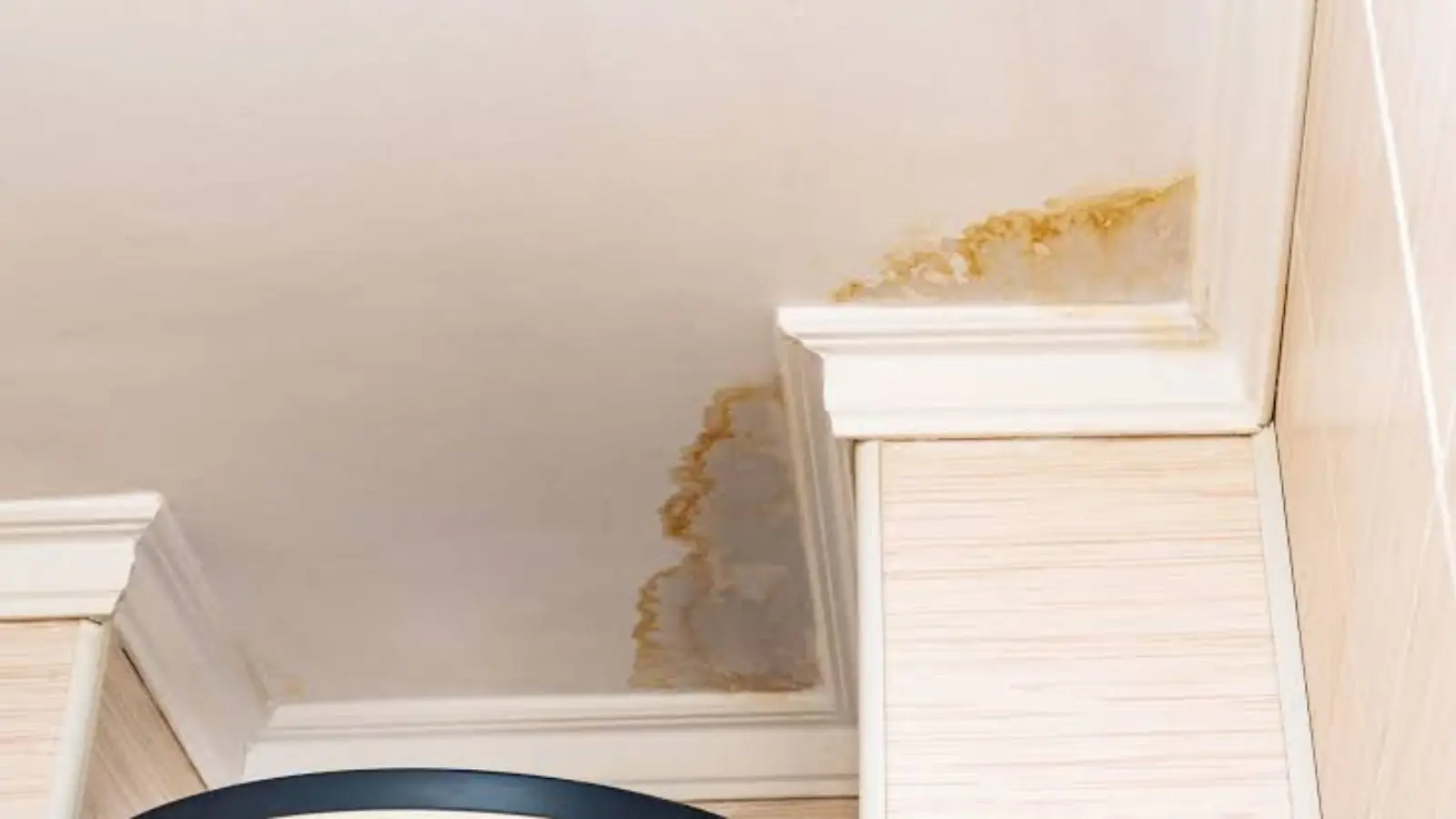
A brown ring spreads across the drywall, and the first question is always the same: where is the water coming from? Finding the ceiling leak source matters because the fix, the repair trade and sometimes the insurance conversation all depend on the answer.
Water rarely drips straight down from its entry point. It runs along framing, soaks insulation and surfaces feet away, so a few simple clues about timing, rain and room above will save you from chasing the wrong pipe.
First, limit the damage
A ceiling that is bulging or dripping steadily can hold a surprising amount of water. Move furniture and valuables out from underneath and set a bucket under the lowest point. If the drywall is sagging, a small hole poked at the lowest spot lets the water drain into the bucket instead of letting the whole panel let go.
Water near light fixtures and outlets
Treat any wet ceiling with a fixture or fan as an electrical risk until proven otherwise.
- Stay out from under a sagging, wet ceiling that has a light fixture or ceiling fan in it.
- If a ceiling light or outlet sits under the stain, switch that circuit off at the breaker, but only when the box is in a dry spot you can walk to without risk.
- Sparks, a burning smell or buzzing from a fixture mean you should get out of the room and phone 911 or the electric utility, ahead of any other call.
- Never reach into a leaking light fixture to see how bad it is.
Read the timing before you climb anything
When the stain appears tells you more than where it appears. Think about the last 48 hours: did it rain, did someone shower upstairs, was the air conditioner running all day? Match your answer to the table below, then confirm with a physical check.
| What you notice | Likely source | What to check |
|---|---|---|
| Stain grows only during or after rain | Roof, flashing, vent boots, gutters | Attic underside of roof deck, flashing around chimneys and vents |
| Drips a day or more after rain stops | Wet attic insulation releasing water slowly | Insulation and framing above the stain |
| Drips when someone showers or flushes upstairs | Shower pan, tub drain, toilet seal, drain line | Floor around the toilet, tub overflow, drain connections |
| Steady leak in dry weather, any hour | Pressurized supply line | Water meter dial with all fixtures off |
| Drips on hot days, worse when AC runs | Clogged condensate drain line or overflowing drain pan | Air handler pan, float switch, drain outlet |
| Stain near an exterior wall after wind-driven rain | Window, siding or stucco entry | Window frame caulk, wall cracks, nearby roof edge |
Check the attic with a flashlight and a meter
If your attic has safe access, go up in daylight with a flashlight and wear a dust mask. Look for dark stains or shiny wet streaks on the underside of the roof deck, matted insulation, and daylight coming through where it should not. Follow the wetness uphill, because water usually enters higher than where it shows.
A pin-type moisture meter on framing and a thermal imaging camera across the ceiling can show wet areas that the eye misses, since wet materials hold a different temperature. Do not walk on a wet roof or try to trace a roof leak from above in rain, since that is how people end up hurt. A roofer is the right trade for entry points on the roof itself.
The upstairs bathroom and the water meter test
If the leak shows up when water is used above, run fixtures one at a time and watch the stain. A shower alone points toward the pan or drain, a flush points toward the toilet seal or supply, and a sink points toward the trap or faucet connection. Check the caulk lines and the tile grout, since small gaps let shower spray reach the subfloor.
For a leak that never stops, shut off every fixture and appliance, then read the water meter. If the small dial or low-flow indicator keeps moving, water is escaping somewhere in the pressurized lines. That points to a plumber, and shutting the main valve until the pipe is repaired will stop further soaking.
AC condensate lines are an easy one to miss
If your air handler sits in the attic or a closet above the ceiling, its condensate pan and drain line can back up and overflow. The sign is a stain that grows on hot days and goes quiet when the system is off. A clogged line, a rusted pan or a tripped float switch is usually the cause, and an HVAC technician can clear and test it.
Because this water is clean at first but sits in a warm, dark cavity, drying it quickly matters. What crews do over the opening one to three days of a leak like this is laid out on the water mitigation page.
Write this down before you call anyone
- The date and time you first saw the stain, and how big it was then.
- Whether it had rained, someone had used the upstairs bathroom or the AC was running.
- Photos of the stain, the ceiling around it and the attic area above it.
- Whether the stain is warm, damp, dripping or just discolored.
- Any water meter reading before and after you turned off all fixtures.
- What you did to limit the damage, with receipts for any supplies.
Ceiling wet and spreading?
A growing stain is worth a call to (626) 879-0276. Dispatch answers at any hour and can arrange a crew to cut an inspection opening and dry what is inside.
Who fixes what
A restoration company dries the structure, removes wet drywall and insulation and documents moisture, but it does not repair a roof, a pipe or an air handler. Hire a roofer for entry points, a plumber for supply or drain lines and an HVAC technician for condensate problems. If the water had been sitting for a while, emergency water removal may be the first call, with rebuilding handled later.
Ceiling leaks and rain in La Puente
The National Weather Service 1991 to 2020 normal for downtown Los Angeles is 14.25 inches of rain a year, with November through March adding up to about 12.42 inches. That is the nearest long-record normal available, not a La Puente gauge. Roofs here sit dry for months, so the first real storm of the season is often when a cracked flashing or a worn vent boot shows itself.
Flood mapping in the city's draft Safety Element leaves La Puente out of the 100-year and 500-year zones, and it lists no susceptibility to riverine flooding. For a homeowner, that makes a wet ceiling far more likely to be a roof, plumbing or AC problem than rising water from outside. Ground-level flooding is a separate issue, and standard homeowners policies exclude flood, so check your policy for how it treats each case.
If you are in Hacienda Heights or Baldwin Park, the same timing clues apply. Once you know the source, our water damage repair work can follow the drying stage.
Frequently asked questions
How do you find where a ceiling leak is coming from?
Start with timing. Rain-linked leaks point to the roof, leaks tied to showers or flushes point to upstairs plumbing, and hot-day leaks point to the AC condensate line. Then confirm in the attic with a flashlight and a moisture meter.
Can a ceiling leak when it is not raining?
Yes. A pressurized supply line, a bathroom drain or an AC condensate line can all leak in dry weather. A water meter test with all fixtures off helps separate supply leaks from the rest.
Is a leaking ceiling an emergency?
It is if the ceiling is sagging, near light fixtures or still dripping. Limit the water, keep clear of electrical risk, and call for help. Wet drywall and insulation are best dried within 24 to 48 hours.
Does a ceiling leak always mean the roof is bad?
No. Many ceiling stains come from bathrooms, supply lines or AC drain overflow. Rain timing is the clue that separates a roof leak from the rest.
Why did my ceiling leak after the first rain of the season in La Puente?
Roofs bake dry for months, and a cracked flashing, worn sealant or dislodged vent boot may only show itself once real rain arrives. Have a roofer check the area above the stain, and have the wet materials dried so mold does not follow.